


Many marketers think demand generation is just another way to say “lead generation.”
But demand generation focuses on attracting visibility, not leads. It’s about educating the market, building brand authority, and creating desire.
This is the main reason demand gen strategies fail. They’re built on the wrong foundation from the start.
So let’s clear the air.
Keep reading to uncover what demand generation really is, how it differs from lead gen, and the five mistakes you’re probably making (plus how to fix them).
Highlights
- Demand generation builds awareness and trust, not immediate leads.
- It focuses on top-of-the-funnel content to educate and engage potential buyers.
- Common mistakes include gating content too early and using bottom-of-the-funnel content.
- Long-term brand building and deep, topic-driven content are key for success.
- Distribute content across multiple channels to maximize reach and impact.
What is demand generation?
Demand gen addresses the 95% of the market that isn’t currently looking to buy.
Instead of forcing a form fill immediately, demand gen often uses ungated, high-value content (such as videos and blog posts) to maximize reach. The goal is to position a brand as a trusted expert to make future lead generation more effective.
Speaking of lead generation …
What’s the difference between demand generation and lead generation?
Here are the main differences between demand gen and lead gen:
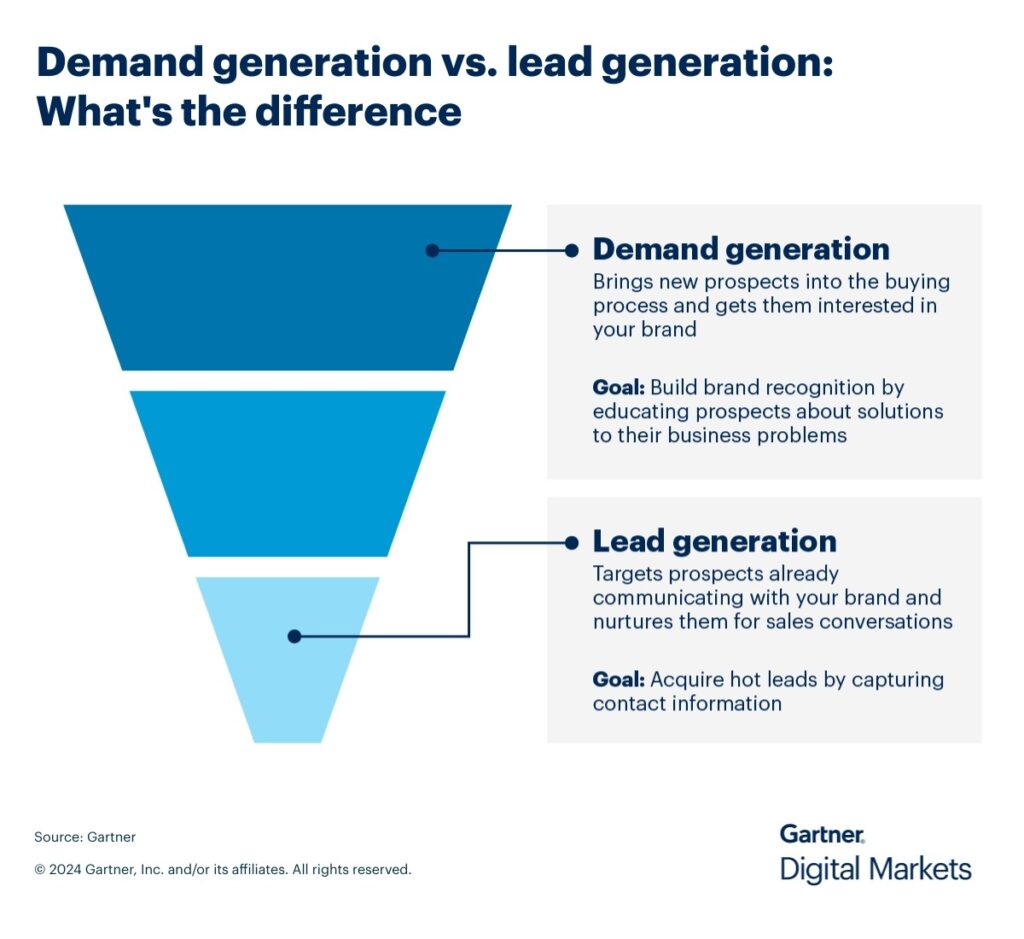
Demand generation (visibility/awareness) targets a wide audience. It educates potential buyers on problems they may not know they have and builds trust over a long period. It’s about creating a thirsty audience.
Lead generation (lead capture) focuses on converting that audience into specific, identifiable prospects. Usually by exchanging contact information for value (e.g., via gated content and demos).
In other words, demand gen serves the top-of-the-funnel (TOFU) and lead gen serves the bottom-of-the-funnel (BOFU).
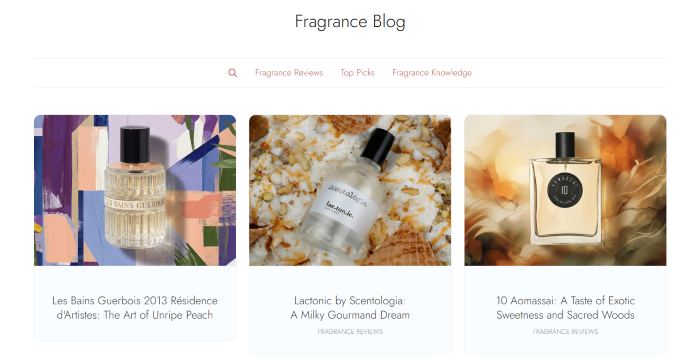
For example, for a niche fragrances campaign, your demand gen tactics would focus on publishing pressure-free content, like valuable, targeted blog posts or videos.
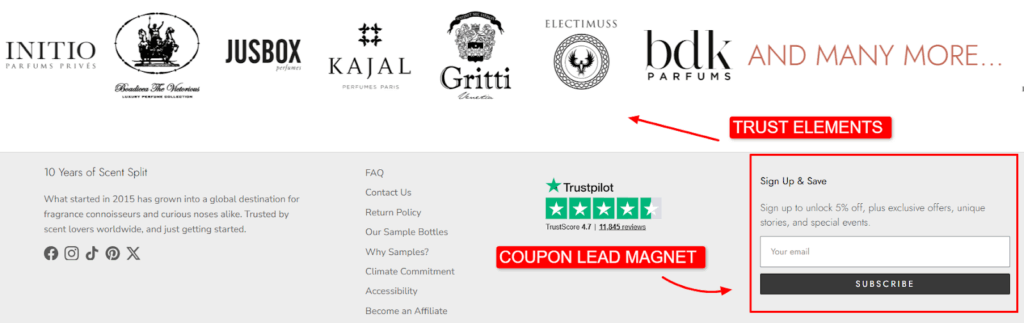
Your lead gen tactics would focus on lead magnets such as gated content, coupons, webinar invites, and demos.
For instance, in its website footer, Scent Split offers 5% off, plus exclusive deals as its email lead magnet.
It also has an exit intent pop-up that’s currently offering an 8% off coupon in exchange for an email opt-in:

As far as metrics go, demand gen focuses on reach and engagement metrics (e.g., brand lift, trust, and awareness, which isn’t always easy to measure). Lead generation focuses on conversion metrics, such as the number of leads or sales generated by a resource.
So what role do leads play in demand gen?
While the core purpose is visibility, modern demand generation sets the stage for leads.
Without demand, lead generation tactics can produce low-quality leads since few people know your brand. But with demand, leads know and trust you, so you can nudge them down the sales funnel. (More on this below.)
TL;DR: Successful companies use demand generation to create awareness (visibility) and lead generation to capture that awareness.
5 demand generation mistakes you might be making and how to fix it
K, off to those demand generation mistakes I promised you.
Mistake #1: You’re gating your demand gen content (a user experience problem)
Demand gen content is meant to be openly educational, not closed.
If leads don’t trust you yet, they’ll be more hesitant to give you their name and email address. So if they head to your site, excited to learn something … and it’s gated? You could lose them in an instant. What was meant to drive leads has now become a lead detractor.
Even if it doesn’t lead to high bounce rates, it could generate ghost leads (aka, contacts that supply fake info).
This happened to me a few months ago when I was offering a tool for writers. Some of the writers used fake names and email addresses to secure the resource.
The fix: Ungate your demand generation assets and only gate your lead gen content assets.
Mistake #2: You’re using BOFU content instead of TOFU content (a funnel-stage problem)
Demand generation strategies primarily focus on the top of the marketing funnel (TOFU).
At this stage, prospects often don’t know that they have a problem or are unaware that solutions exist. That’s why the primary goal is to generate awareness, build trust, and educate them on their pain point.
For example, a SaaS team might struggle with messy handoffs between their sales team and customer success. (But not see it as a real issue yet.) Instead of pushing software immediately, TOFU content would focus on topics such as “how poor handoffs slow revenue growth,” helping them recognize a bigger problem to solve.
Yael Miller, director of content marketing at monday.com, talked about this recently.
In a recent interview with Erik Jacobson from Hatch, Yael spoke about how monday.com has built a content strategy that’s designed to build trust with the 95% of potential buyers who aren’t actively looking for a solution yet.
This interview is gold. But what stuck out to me is when Yael said:
“Just give them value. Don’t try to sell them anything. Don’t try to force them down some sort of funnel. Don’t get them into some sort of nurturing flow. Give them information that will actually help them succeed in their workplace.”
And then, hopefully, in a few months from now, in a year from now, in two years from now, when they’re thinking about a solution, they might say: ‘Oh, what about monday? I remember I read something really interesting from them.’”
The fix: Use TOFU content for your demand gen strategies. Share relevant solutions, information, trends, or insights. Use BOFU content for your lead gen strategies.
Mistake #3: You’re focusing on short-term revenue instead of long-term brand building (a perspective problem)
Demand generation is a long-term play, not a short-term approach.
Especially in B2B marketing.
I recently read a post by an SEO strategist on LinkedIn that said that BOFU content is what leads remember most when they’re ready to buy. (I won’t name-drop them out of respect.)
But Gartner research proves otherwise.
Gartner found that more than 60% of software buyers eventually choose the brand they had in mind at the start of their search. This surprised me, because I didn’t even think they remembered their initial searches! And as marketers, we’ve always been told that more BOFU content = higher conversion rates.
In fact, Gartner mentioned you could be compromising future sales by omitting TOFU content.
The fix: View your demand gen content as long-term brand building. This may mean educating your team, stakeholders, and anyone else involved in your business growth so they understand your strategy.
Mistake #4: You’re comparing products instead of sharing topical depth (a content problem)
At the top of the funnel, users are interested in a topic. They’re thinking about a goal they want to achieve or a frustration, not a specific product or company.
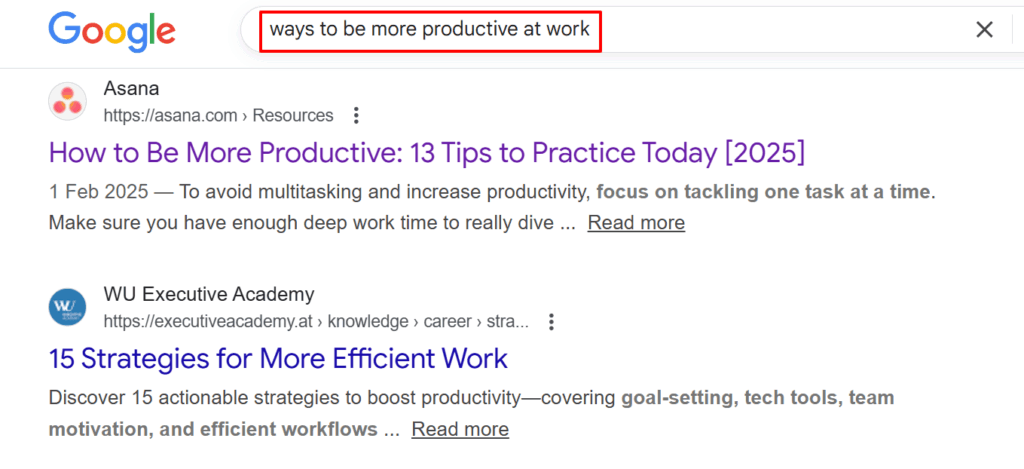
The fix: To move these users further down the funnel, focus on building demand through passive engagement and content depth.
For example:
- Focus on pain points (the PAS Model): Use content that illustrates the problem, agitates the pain with real-life examples, and then introduces the solution without being promotional.
- Create educational content: Publish blog posts, videos, and social media content that addresses target audience needs, trends, and frustrations.
- Lean into behavioral triggers: Instead of highlighting product features, focus on the behavioral, day-to-day inefficiencies they’re experiencing.
- Build authority: Use digital PR and thought leadership to build trust and brand awareness before engaging directly.
Mistake #5: You’re not distributing your content across multiple channels (a content distribution problem)
Content needs distribution to scale and command Share of Voice (SOV) in your industry. If you’re only publishing content on your website and never distributing it, you’re missing out on a ton of potential website traffic and brand awareness.
(Not to mention, social media shares, backlinks, and user-generated content.)
SEO is more well-rounded now. Platforms, like X, YouTube, LinkedIn, and Instagram, are ranking in search engine results and getting cited by LLMs.
To capitalize on this without burning out your team, I recommend creating one valuable blog post per target keyword. And then repurposing snippets from it across multiple channels.
For instance:
- Grab a video from your blog post, copy and shorten it, and repurpose it as an Instagram Reel.
- Pull expert quotes from your blog and share them on X with your insights.
- Reshare an infographic from your blog on LinkedIn.
- Reshare a larger blog video on YouTube.
Sharing helpful, ultra-specific social media content that’s tailored to your target audience can also help with getting followers on Instagram, X, LinkedIn, and YouTube.
You can also buy followers. But make sure to buy from a well-vetted source, like Superviral.
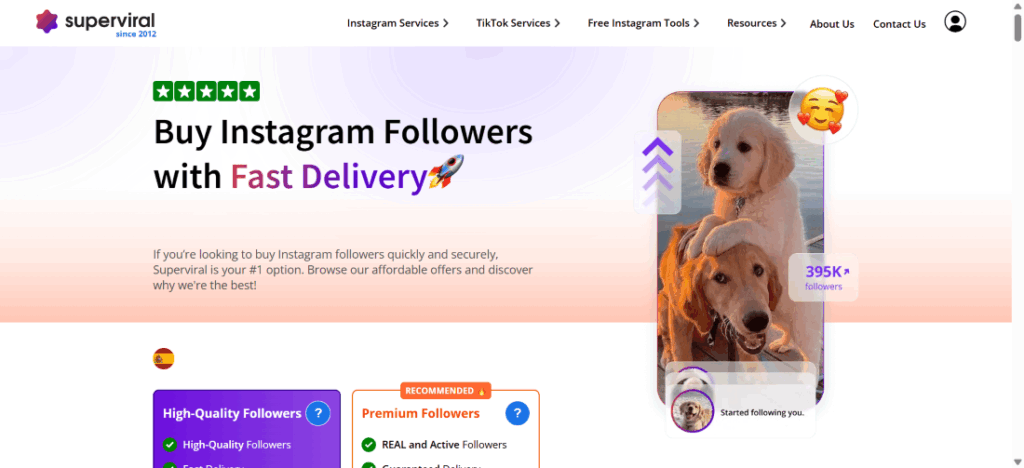
The more high-quality followers you have on social media, the greater your potential to generate demand for your business.
How to create a demand gen strategy that builds trust with ideal customers
To create a demand gen strategy, follow this simple checklist:
- Start by defining your target audience and building detailed buyer personas. Figure out the problems they face and what questions they’re searching for.
- Next, plan top-of-funnel content. Content assets that work well here include blog posts, videos, guides, or infographics. (Educate without asking for anything in return) Uncover keywords with informational intent using Ahrefs or Semrush and target just one topic per asset.
*Pro-Tip: Choose keywords with low-competition.
- Make sure your content is easy to find. Have it clearly labeled on your site. And make sure to share it on social, repurpose it in email, and optimize it for semantic search.
- Finally, track engagement metrics like page views, time on content, and social shares. Use those insights to refine your approach.
This takes a legit team to make happen, though, so consider reaching out to Codeless for full-service support.
Wrap up
Stop forcing leads at the top of the funnel. Create value and visibility first. And then ask for contact info.
For good measure, here’s a quick recap on the top five demand generation campaign mistakes to avoid:
- Gating your demand gen content.
- Using bottom-of-funnel content instead of top-of-funnel content.
- Prioritizing short-term revenue over long-term brand building.
- Focusing on product comparisons instead of deep, topic-driven content.
- Not distributing content across multiple channels.
Psst … Want better demand gen content? Get a content strategy plus pro-written pieces in your brand voice by Codeless. Book an intro call now.
FAQs about demand generation
What is demand generation?
Demand generation means educating the market and shaping how people think about a problem. Long before they’re ready to buy. It creates awareness, trust, and preference. Not leads.
How is demand generation different from lead generation?
Demand gen builds understanding and intent at the beginning of the customer journey. Lead gen kicks in later and asks for contact details. (For email marketing campaigns, demo calls, webinar invites, etc.) Demand gen makes people care. Lead gen creates a sales pipeline and nudges leads to convert.
Why is demand generation important for businesses?
Because buyers do their homework before talking to a sales team, demand gen ensures your brand is part of that learning phase. So when buyers are ready, you’ve already gained their trust.
What channels work best for demand generation?
Channels that educate at scale include evergreen content, social, video, communities, podcasts, events, and brand-led paid media. The goal is reach, resonance, and a strong market presence.
How do you measure demand generation success?
Look at awareness and engagement signals. (Like brand search, content consumption, social engagement, time spent, audience growth, and influenced pipeline.) If people recognize you before sales reaches out, it’s working.
What role does content play in demand generation?
Content is demand generation. It teaches, reframes the problem, challenges assumptions, and builds credibility.
Can an SEO content agency help me create demand gen content?
Yes, an experienced SEO agency can create demand generation content for you.
They can craft blog posts that educate your audience, create videos that explain complex topics simply, and develop social media snippets that spark engagement.
For example, they might produce a series of “how-to” guides for your industry, turn one guide into multiple short videos for LinkedIn and X, and design infographics for your website to boost shares and backlinks.